Describe it in plain words. PRONOIA builds it in Ansys STK or NASA GMAT, runs the analysis and sends back verified results and a full report. Your first mission is free, with results within hours.
PRONOIA is an AI mission engineer. It works the way you would, only faster: it plans, asks what is missing, builds the scenario in Ansys STK or NASA GMAT step by step, checks the numbers and writes it all up.

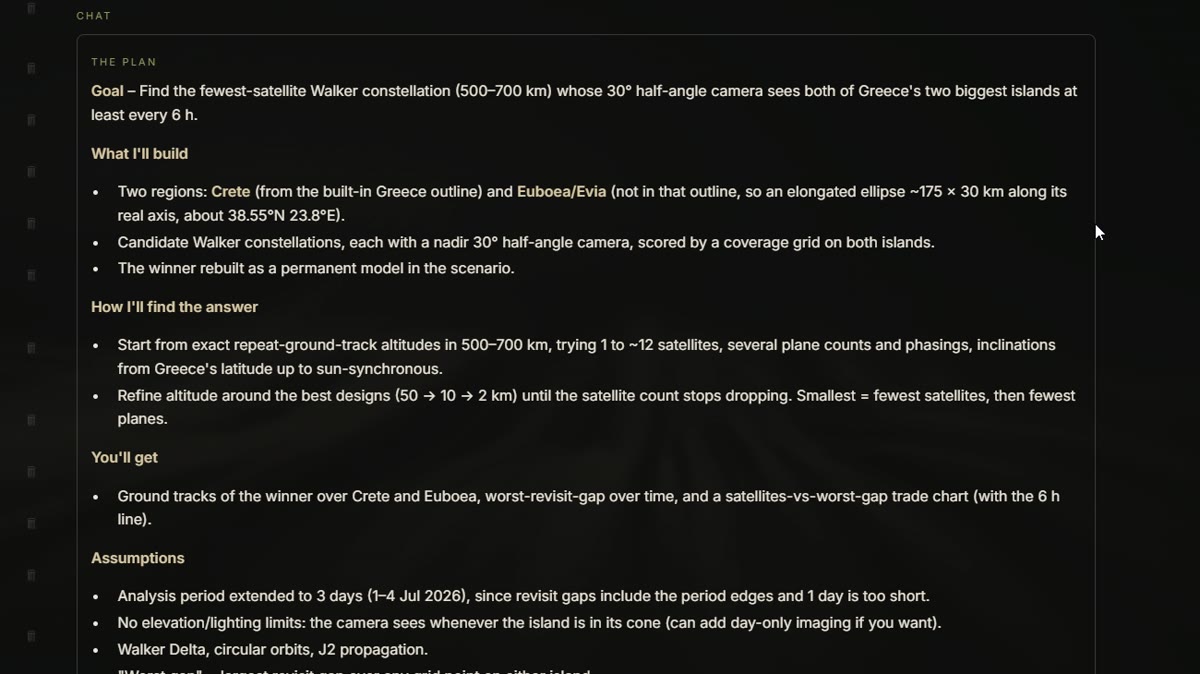
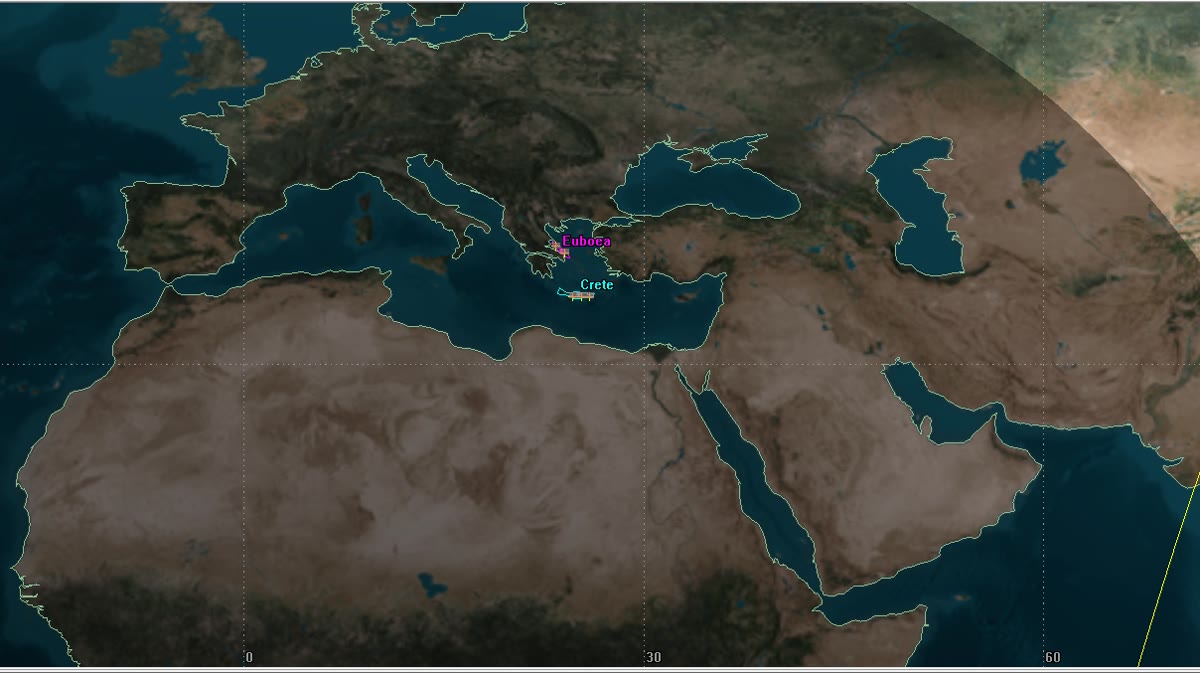
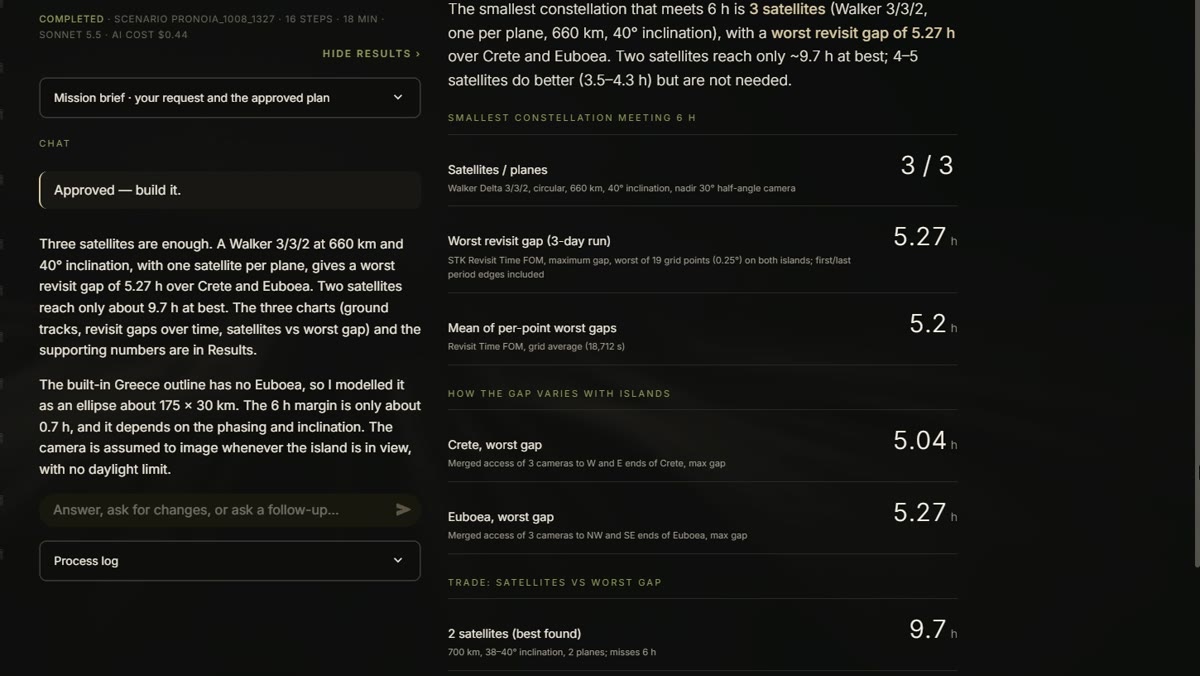
“Smallest Walker constellation that revisits Crete and Euboea every 6 hours.” PRONOIA proposes a plan with its assumptions. Nothing runs until you approve.

Satellites, sensors, coverage grids, link budgets, manoeuvres: built and run in STK or GMAT with a tested automation library for each. It searches design options, not just one guess.

Key numbers with the engine computation behind each one, charts, caveats, a recommendation, and a report ready to send.
If your team has STK, PRONOIA builds and runs the scenario live in it and hands you the scenario file.
No STK licence? GMAT.Free and open source. PRONOIA installs and drives it, with the same plan, hand checks and report.
Every quantitative validation case was run on both engines with the same blind prompt. GMAT is developed by NASA Goddard Space Flight Center (Apache 2.0). PRONOIA is independent and not affiliated with or endorsed by NASA or Ansys.
Recorded runs, replayed step by step: the request, the plan, every engine step, the results with their sources, the pictures and 3D views, and the report. Pick a mission.
Best on a large screen. Open the demo full screen · Watch the 60-second film
Simulated from public satellite and aerial imagery, not live. PRONOIA renders the ground through your camera at your satellite's real viewing geometry.
Pass times, off-nadir angle, Sun, clouds and image quality are computed for each opportunity; the picture shows the ground as it was recorded, not on the day.
Pictures from real PRONOIA missions, drawn with CesiumJS from the engine's ephemeris.
Before we ask you to trust it, we checked it. Blind prompts, the normal workflow, and results compared with published analyses and real flight data.
| Case | Reference | STK | GMAT |
|---|---|---|---|
| CubeSat contacts and eclipses | Published PW-Sat2 mission analysis | Pass · found a RAAN error | Pass |
| CubeSat orbital lifetime | Measured re-entry of GuaraníSat-1 | Pass · within 8 % | Pass · within 4 % |
| Earth-observation revisit | ESA Sentinel-2 published revisit | Pass · exact | Pass · exact |
| LEO broadband link budget | Acta Astronautica study | Pass · found inconsistencies | Pass |
| Lunar frozen orbit | NASA technical paper | Behaviour matched | Behaviour matched |
| Concept study: Greek contribution to IRIS² | Open design question | Concept delivered | — |
| Earth–Mars transfers, 2028–29 and 2031 | NASA Mars mission-design handbook | Pass · 8 / 8 | Pass · 8 / 8 |
Coverage, revisit, contacts, link budgets, transfers, lifetime: tell us what you are trying to find out. We run it with PRONOIA and reply with the results and the report, usually within a few hours for a standard mission.
Send it to [email protected] with: the mission (orbits, payload, ground stations), what you want to find out, and your deadline.
Your request is used only to answer it. Please don't send classified or export-controlled data. See the privacy note.
No. There are two ways to work with PRONOIA. We run it in STK: send us the mission and we return the results, charts and report. In your STK: PRONOIA runs on your own computer next to your own Ansys STK licence, so missions and scenarios stay with you. The free analysis uses the first way. No STK licence? PRONOIA also runs on NASA GMAT, which is free; it installs it for you.
No. Every number is computed, never typed in by the AI. Orbits, access, coverage, eclipses and transfers are computed by the engine. With STK almost everything comes from the engine itself. GMAT has no built-in link, coverage-quality or sizing tools, so PRONOIA works those out with its own calculations (link, power, mass and propellant budgets), runs them in Python and labels them "Sizing" with every assumption listed. Key results are checked twice: against an independent hand calculation, or by flying the answer again in the engine, and the report shows each check. The AI chooses the method, so the report also says how each number was found, for an engineer to review.
Constellation coverage and revisit, access and contact windows, link budgets, orbit transfers and Δv, drag lifetime, sun-synchronous and repeat-ground-track design, and concept trade studies. Ask if you are unsure.
We use what you send only to run your analysis and reply. When PRONOIA runs in your STK, missions and scenarios stay on your own computer.
PRONOIA is built by Marios Louvros, a space systems engineer, in Greece. We are looking for design partners and early customers in NewSpace, established space companies and university teams.